
Yes indeed — This is the opening position of a fresh Artistic-puzzle, though it may look familiar.
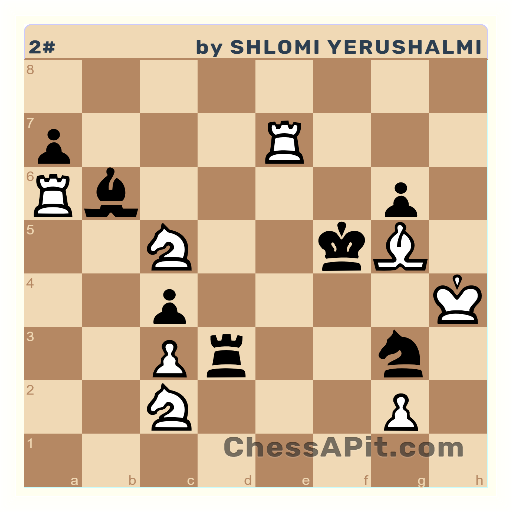
(This time it is White’s turn, while the position you recall had Black to move.)
Having just solved
the previous puzzle — by a winning zugzwang — you now recognize the interesting situation: In today’s starting setup, it is White who prefers to pass the move, if only the rules of chess would allow it. But they do not.
So we are left with the question: Is there a move White can play right now that keeps every mating net intact, without spoiling a single one of his prepared checkmates?
And we are also left with, of course, another mate-in-two challenge.
But not just any problem — this one stands among the most striking creations we have encountered. Here, the composer ‘Shlomi Yerushalmi ‘ demonstrates extraordinary artistry, weaving layers of elegance and sophistication into the tight fabric of the 64 squares.
Good luck and we’re sure you’ll enjoy it 🙂
📖Read more about this Art-Puzzle
Suggestion: Try solving it yourself first
Solved it yet?
Read more
In the presented position, White already has an immediate mate prepared against any Black move:
➡️ If the ♞ moves — ♙g4#.
➡️ If the ♝ moves — ♖f6#.
➡️ And if the ♜ travels — the ♘ from c2 delivers the appropriate mate (d4 or e3).
It almost looks as if White has already played his first move. Was the puzzle accidentally shown with the solution? Not at all 🙂. It is White to move, and he cannot simply maintain the current setup. We must find the “spoil in order to repair” move.
The key is 1.♘e4! — a pure zugzwang move, with no immediate mating threat.
This does spoil the original possibility of the ♘ on c2 responding to a ♜ move (since the opened line of the ♝ now covers d4 and e3). However, the newly placed ♘e4 takes over and will itself deliver mate according to the ♜’s direction (d6 or g3). Don’t worry—the knight from c2 isn’t dismissed; his help will still be needed shortly.
After 1.♘e4! , the situation is:
➡️ If Black moves his ♞ — ♙g4#.
➡️ If Black moves his ♝ — ♖f6#.
🔍 ➥Except for the special move ♝d4 , which keeps f6defended 🤓
➡️ If Black moves his ♜— the ♘(e4) delivers the appropriate mate.
🔍➥Except for the special move ♜d4, which prevents that knight’s action 📌
In each of these special moves to d4 , the arriving Black piece (♝ or ♜) blocks the other💡
1.♘e4!
…♝d4 → ♘d6#
…♜d4 → ♘e3#
🗝️We especially liked:
💎 The mutual blocking of ♜ and ♝ on the square d4 . At first glance it seems almost incidental, yet it greatly enriches the problem. Here we see not only the replacement of prepared mating moves with new ones, but also the addition of a very cool twist 🤓 .
💎 The composer’s careful decision to give the lower ♘ an active role in the second act of the show impressed us a lot. Not only because of his “consideration for the knight’s feelings” 😊, but also due to an unwritten rule of fairness in mate-in-two problems: one should not place unnecessary pieces on the board just to confuse the solver. After all, the true artistry is not only in making a puzzle difficult, but also in making it elegant and beautiful. The composer made sure that every piece on the board has (at least one) role to play — both in the previous position and in the one shown here.
💎 And finally, there is a very nice “Almost-solution” : ♖e8 … Did you think of that?
A really impressive and clever piece of work, thank you very much. I especially enjoyed solving it after the preparation puzzle you posted earlier – it highlights the changes in the moves of the responses. And the Grimshaw chess that was created here almost by itself really adds to the enjoyment.
Hi Davis,
Thank you for such a thoughtful and generous comment. ♟️
We’re especially glad you solved it in sequence — that contrast between the preparatory puzzle and this one is exactly where the idea comes into focus. And yes, the Grimshaw emerging almost “on its own” is one of those moments that makes a composition particularly satisfying.
– The ChessAPit Team
Genius puzzles like this are why I come to this site. Keep making us marvel and impressed.
Hi Ava Rodriguez,
Thank you — comments like this truly mean a lot to us. ♟️
Knowing that these puzzles spark curiosity and wonder is exactly what keeps us going. We’re glad you’re here with us.
– The ChessAPit Team